
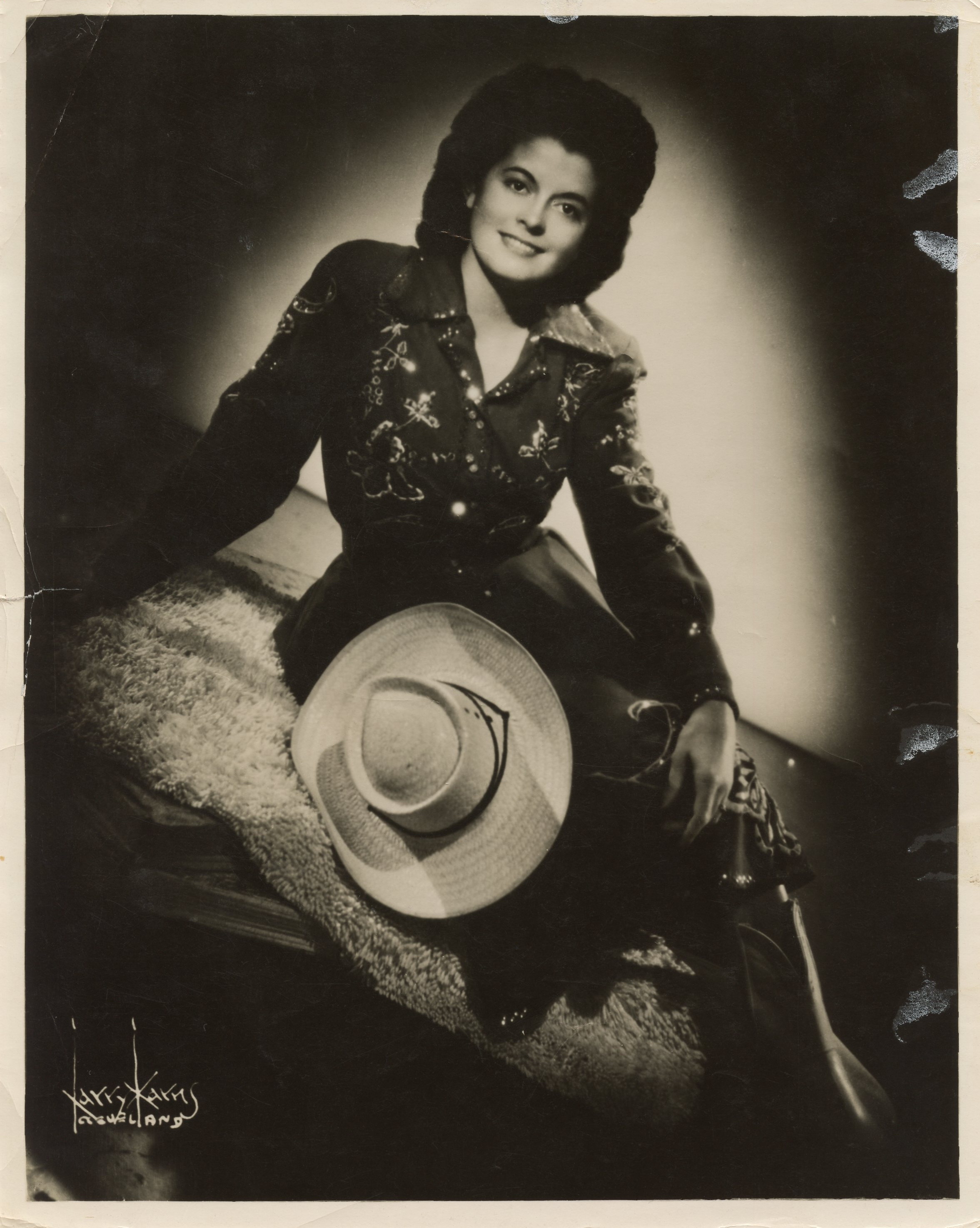
Chickie Williams.
Today is her birthday. February 13th.
“The Girl with the Lullaby Voice,” Chickie Williams was a longtime fixture of country radio’s seminal Wheeling Jamboree, scoring a Top Five hit via the 1948 smash “Beyond the Sunset.” Born Jessie Wanda Crupe in Bethany, WV, on February 13, 1919, she was a devoted fan of the Jamboree, the live country music barn dance aired each Saturday night via Wheeling station WWVA. In 1935, she wrote to the program’s star attraction, Doc Williams and His Border Riders, requesting they make a live appearance at the Reawood Dance Hall in Hickory, PA. Crupe and Williams soon began a romance, finally marrying in 1939. After giving birth to the couple’s three daughters, she adopted the stage name Chickie Williams and joined her husband’s Jamboree act in August 1946, contributing harmony vocals and later upright bass fiddle. Two years later she notched her biggest hit with an original arrangement of the hymn “Beyond the Sunset,” subsequently recorded by country legends including Hank Williams and Red Foley. Chickie was also a regular participant in Doc’s pioneering tours throughout the northeast U.S. and Canada, and remained a Jamboree castmember for 52 years, retiring alongside Doc (a 61-year veteran of the series) in 1998. After a long illness, Chickie died in Wheeling on November 18, 2007. ~ Jason Ankeny, Rovi
Read more: http://www.answers.com/topic/chickie-williams#ixzz1m13rqnGn
I became a huge fan of hers when I was nine. And this is how:
All of the kids in our neighborhood went to St. Catherine’s on Sunday mornings for catechism. This meant we gathered in the basement in groups according to age and gender and were terrorized by the nuns into memorizing prayers and learning what sins would send us to purgatory and hell.
Then we would sit on folding chairs in the basement, boys on one side of the aisle and girls on the other, for Mass. Seating was according to age. No fidgeting was allowed. We were certainly not invited into the church itself, unless it was to go to confession on Saturday afternoons and tell the priest we’d skipped church last Sunday to go to the lake with our grandparents.
We were not allowed to eat (Communion, you know), so as a skinny little hypoglycemic girl I would regularly faint during Mass. The basement was stuffy and humid in the summer and on top of an empty stomach I just couldn’t help keeling over. One of the nuns would half-drag me to a room beside the altar where there was fresh air coming in from a side door. Thank God for fresh air.
Anyway, when it was my father’s turn to pick us up after church (the neighbors carpooled), he would go early and stop at a tiny used record store in order to browse through the albums. For twenty-five cents he found Chickie Willliams.
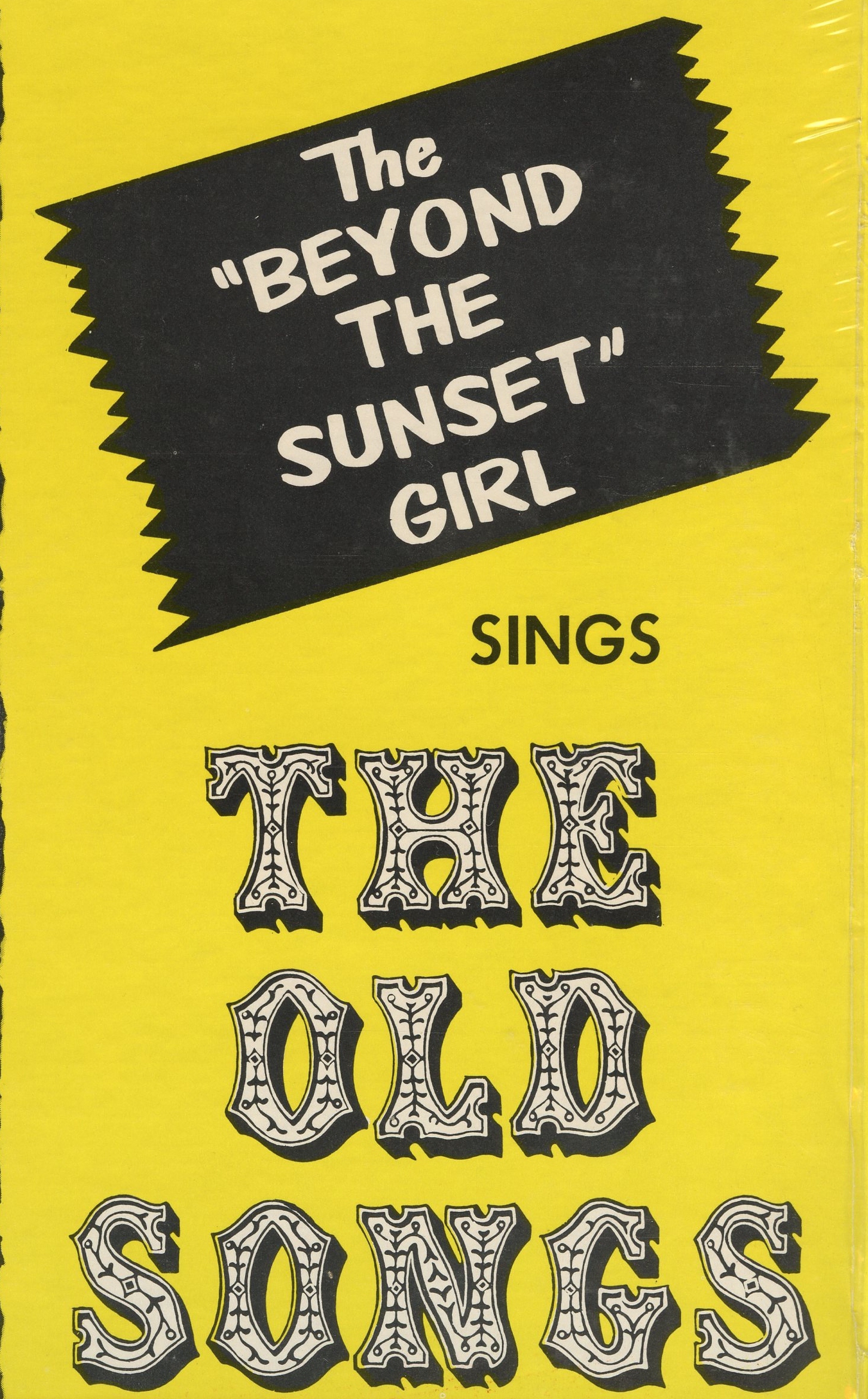
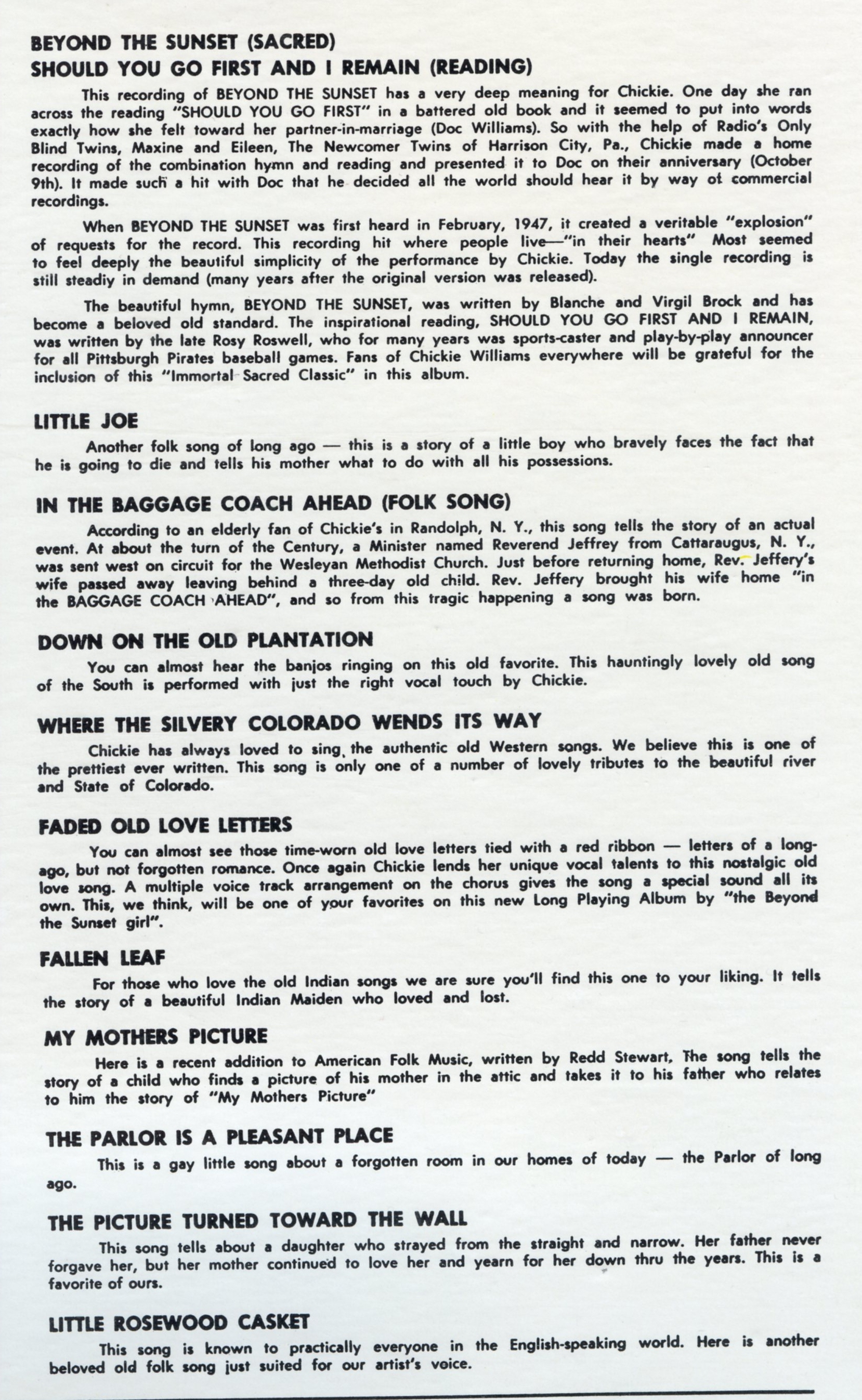
We had been given a portable record player by a departing-for-sea Navy friend, but we didn’t have many records for it (hence my Dad’s search for inexpensive vinyl). We hit gold with Chickie. She sang sad songs about dead mothers, missing children, dying sons, dead lovers, scandals, and lost love. I memorized every one of them. My father’s idea of entertaining friends was to sit my brother and me on top of the picnic table and have us sing, “The Baggage Coach Ahead” (a personal favorite of mine), about a young man traveling with the corpse of his wife on the train while his baby cries.
When Banjo Man and I were on our first road trip together (we’d been married 9 months), I entertained him by singing my repertoire of Chickie Williams songs as we drove across Nebraska.
He didn’t know whether to be impressed or appalled. And then he became a fan, too.
Have a listen:
http://www.youtube.com/watch?v=tUEhU2bxoQY&feature=related



 is there any more pie?