There’s nothing like a police chase to make for an interesting day.
Banjo Man says that makes me sound crazy. I’m sorry if it does, BUT I am tired of cleaning, of sewing, of cooking, of British history, of worrying about Covid and cancer and construction schedules. Not in that order.
So I ask you, if a huge police event was happening in your neighborhood, would you want to watch?
Or have I lost my mind, as my poor husband fears?
As we stayed tucked away in our house yesterday afternoon (day 10 of our personal lockdown), all sorts of things were happening in The Outside World. Namely, a man in Massachusetts had burned his house down, fled the police after taking a few shots at them and, brandishing a weapon, headed towards RI in his Toyota truck.
This wouldn’t have gotten my attention, except for the fact that, according to local radio news, he was now–hours later– driving towards my town.
And as he headed south (at the speed limit, by the way) across the state, over the Newport bridge and back, cruising on to Route 1, he was followed by an increasing number of police vehicles. I heard all about it on the radio and then–lo and behold–heard the parade of police sirens as they streamed past us on the highway.
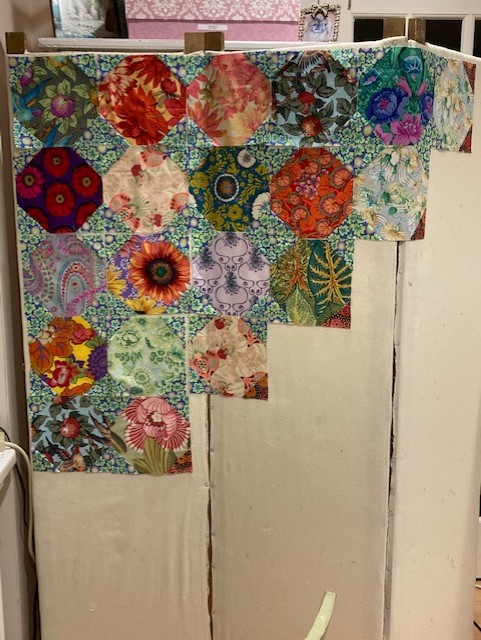
A Boston tv station broadcast the live stream from a helicopter, so my afternoon was spent ironing quilt blocks while watching a white truck navigate familiar roads. He drove past Walmart, went into downtown Westerly, passed my YMCA, took some back roads and then ended up heading towards I-95 on the 78 Bypass. I couldn’t believe what I was watching. And then, rear ended by a police car, went into a bit of a spin and landed gently–in slow motion–against a tree in a wooded area just over the Connecticut line.
Even more time was spent waiting for the guy to get out of his truck. I think there were twenty SWAT team guys surrounding him. The shirtless driver continued to hang out the driver’s window and yell at the police. It looked like he was drinking a beer and holding a pistol, but the video was a bit fuzzy.
The standoff took a while, like a scene from an action movie. The helicopter hovered. The police shot pepper spray from their rifles. An armored truck edged closer to the truck’s tailgate.
Nothing like this had ever happened before in our little rural part of Rhode Island.
Fortunately no one was hurt, the “fugitive” was eventually hauled out of the truck through the window. He was handcuffed, given water, and then an EMT saw to the cuts on his forehead. He was treated kindly.
I’m glad I’m not a policewoman. And on a SWAT team. I don’t know how they participate in a day-long car chase and a 90-minute standoff without having to go to the bathroom.
I wouldn’t have minded being in the helicopter, though. Or operating a drone from two miles away.
We all have our little fantasies.
So today I am drinking coffee and looking at quilt blocks and planning to get gas in the car and check the air in the tires. I am contemplating baking a cranberry cake to take with us to the New Haven hotel.
In other words, back to normal. And that’s just fine, too.













 is there any more pie?